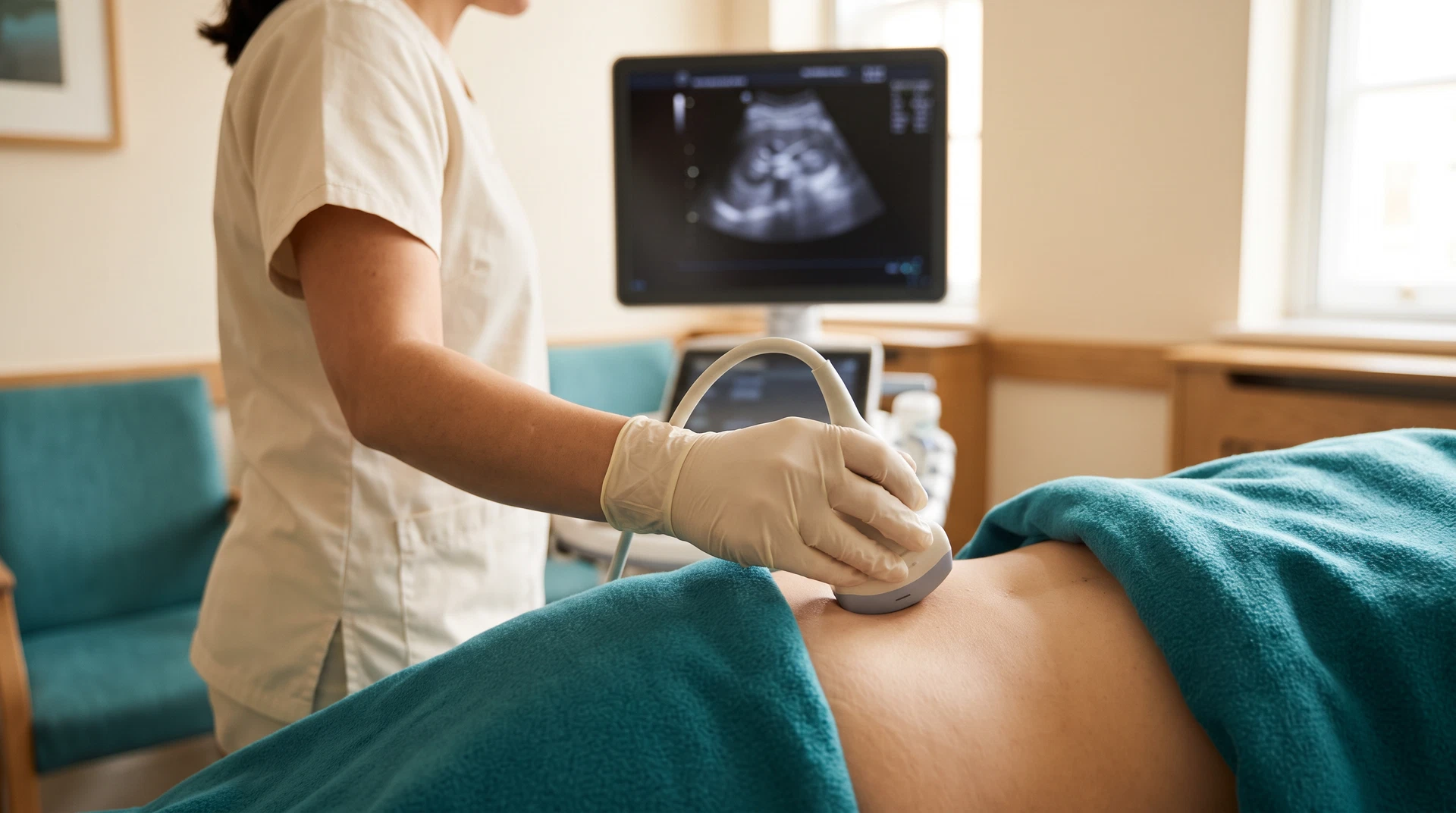
Chronic kidney disease affects approximately 1 in 10 adults in the UK, yet most people with early-stage disease are unaware of their diagnosis.[2] Renal ultrasound is a safe, non-invasive scan that provides detailed images of both kidneys, the ureters, and the bladder — helping to identify stones, cysts, obstruction, structural abnormalities, and signs of chronic kidney disease.[3]
When to Have a Kidney Ultrasound
- Loin (flank) pain or renal colic
- Blood in the urine (haematuria)
- Recurrent urinary tract infections
- Abnormal kidney function blood tests (raised creatinine, low eGFR)
- Family history of polycystic kidney disease
- Monitoring known kidney stones or cysts
- Unexplained high blood pressure (to assess renal artery stenosis)
- Pre-operative assessment before kidney-related procedures
What the Scan Detects
| Finding | Ultrasound Appearance | Clinical Action |
|---|---|---|
| Kidney stones | Echogenic focus with posterior acoustic shadow | Size-dependent: observation, lithotripsy, or surgical referral |
| Hydronephrosis | Dilated renal pelvis and calyces | Investigate cause of obstruction (stone, tumour, stricture) |
| Simple cyst | Anechoic, thin-walled, no internal echoes | Benign — no treatment needed unless very large |
| Complex cyst | Internal septations, calcification, or solid components | Further imaging (CT/MRI) to exclude malignancy |
| Renal mass | Solid lesion within kidney parenchyma | Urgent referral — CT staging and urology review |
| Small/scarred kidneys | Reduced size (<9 cm), irregular cortex | Suggests chronic kidney disease — correlate with eGFR |
| Polycystic kidneys | Multiple bilateral cysts, enlarged kidneys | Genetic counselling, monitoring, BP management |
How to Prepare
For a renal ultrasound, you will be asked to drink approximately 1 litre of water in the hour before your appointment and avoid emptying your bladder. A full bladder provides an acoustic window for imaging the lower ureters and bladder. The scan takes 15–20 minutes and is completely painless.
From Our Practice
"Kidney stones are one of the most common reasons patients attend for renal ultrasound. The scan can identify stones as small as 3–4 mm and assess whether there is any obstruction. For patients with recurrent stones, I combine ultrasound with blood and urine analysis to identify metabolic risk factors and reduce recurrence."
— Dr George Xynopoulos, Consultant Physician
Frequently Asked Questions
Is a kidney ultrasound painful?
No. It is completely painless. You may feel slight pressure from the probe on your abdomen or back.
Do I need a full bladder?
Yes. Drinking approximately 1 litre of water in the hour before your appointment ensures optimal imaging of the bladder and lower ureters.
How quickly will I get results?
Results are discussed immediately after the scan. A written report is available within 24 hours.
Can ultrasound detect kidney cancer?
Yes. Solid renal masses are clearly visible on ultrasound. If a suspicious lesion is identified, I arrange urgent CT staging and specialist referral.
Do I need a referral?
No. You can book directly at Victoria Medical without a GP referral.
Is there any radiation?
No. Ultrasound uses sound waves, not radiation. It is completely safe and can be repeated as often as needed.
Related Guides
Abdominal Ultrasound
Full abdominal imaging guide
Abdominal Pain Causes
When to investigate
Blood Tests
Kidney function testing
Ultrasound Scans
All scanning services
References
- [1] NICE CG182. Chronic kidney disease in adults: assessment and management. 2014 (updated 2021). View source
- [2] Kidney Research UK. Kidney disease facts and stats. 2024. View source
- [3] O'Neill WC. Renal relevant radiology: use of ultrasound in kidney disease and nephrology procedures. Clin J Am Soc Nephrol. 2014;9(2):373–381. View source
- [4] NICE NG12. Suspected cancer: recognition and referral. 2015 (updated 2023). View source
- [5] Türk C, et al. EAU Guidelines on urolithiasis. 2024. View source
- [6] KDIGO 2024 Clinical Practice Guideline for CKD. Kidney Int. 2024;105(4S):S117–S314. View source
